Step-by-Step


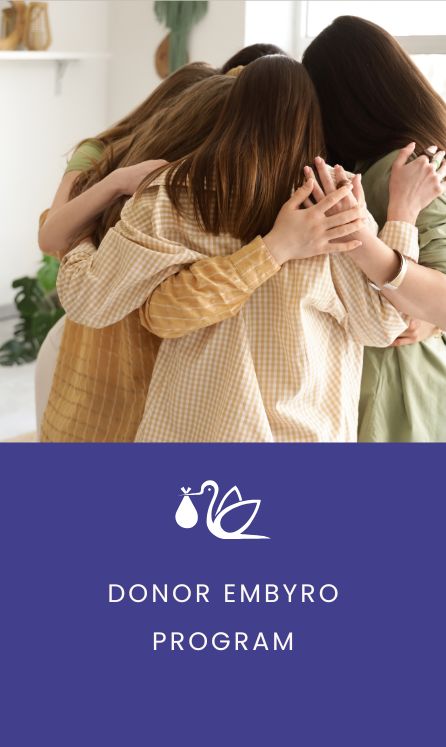
Choosing a donor embryo can bring both hope and complexity. For many people, it’s a path that feels more attainable—emotionally, medically, or financially—especially after a long fertility journey. If you’re considering embryo donation, you deserve a team that can explain your options clearly, support the emotional side of the decision, and build a transfer plan that prioritizes safety and success.
At Hanabusa IVF, we approach donor embryo care with compassion and precision—because even when embryo creation isn’t part of your plan, transfer timing, uterine readiness, and coordination still matter.

Embryo donation is often a faster, more cost-conscious path—but success still depends on a well-prepared uterus and a carefully timed transfer. We make the process feel organized, respectful, and clear.

Even with a donated embryo, the transfer plan must be tailored—natural vs. medicated cycles, lining readiness, and timing matter.
We focus on testing that changes decisions so you don’t waste time.
We generally recommend single embryo transfer when appropriate to reduce risks associated with multiples.
We help align documentation, embryo logistics, and scheduling to minimize delays and confusion.
Embryo donation involves identity, grief, and meaning—we support your decision without pressure or assumptions.



Donor embryos can reduce the uncertainty of egg retrieval and embryo development—especially for patients with POI, severe DOR, repeated IVF failure, or a desire to avoid multiple cycles. But transfer success still depends on uterine readiness, timing, and a supportive plan that avoids avoidable mistakes.
You want a path that may be faster and more cost-conscious than repeated IVF cycles
You have POI/POF, severe diminished ovarian reserve, or repeated poor embryo development
You’ve had multiple failed IVF cycles and want a different path forward
You want to avoid stimulation medications and egg retrieval
You are a single parent by choice or LGBTQ+ family building and donor embryo fits your goals
You feel ready for a family-building path that isn’t centered on genetics
You want to pursue pregnancy using your own eggs first (we can outline a time-limited plan)
You’re deciding between donor eggs and donor embryos and want help understanding differences
You have untreated uterine factors that may need evaluation before transfer

Program and legal/administrative aspects of embryo donation (varies by source/program structure)
Embryo storage and shipping (if applicable)
Recipient evaluation testing (ultrasound, saline sonogram/hysteroscopy if indicated)
FET cycle type (natural vs. medicated) and monitoring frequency
Medications (if using a medicated transfer cycle)
Additional transfers (if more than one embryo is available and needed)
Often included: FET transfer procedure (package-dependent)
Often separate: medications, certain imaging/procedures, storage/shipping, additional transfers
Donor embryo success depends on multiple factors: embryo quality and stage at freezing, the age of the egg source at time of embryo creation (when known), uterine health, and transfer timing. We’ll review what is known about the embryo(s) and discuss realistic expectations based on your medical history.
Embryo development and quality
Sperm parameters (partner or donor)
Uterine cavity and lining environment
Transfer timing and protocol selection
General health factors that affect pregnancy
Often faster than egg retrieval-based pathways, depending on embryo availability and logistics
You may need minimal medication (natural-cycle transfer) or a medicated protocol to support the lining
A brief outpatient procedure
Pregnancy testing and early monitoring plan to reduce uncertainty



.png)

.png)
.png)

You’re a fit for Traditional Fertility Care if any of these statements resonate with you:
You’re just getting started
You want clear first steps
You’ve explored clinics, but still feel at the beginning
You need fertility testing
Your labs look reassuring
Your situation feels straightforward
You have fewer complicating factors
You’re considering IUI
You’re new to IVF
You’re planning an FET
You’re considering PGT
If anything, complex becomes evident, we smoothly upgrade your pathway.
You’re a fit for Complex Care if any of these statements resonate with you:
Low AMH/AFC or DOR concerns
You have Diminished Ovarian Reserve (DOR)
You have POI or high FSH concerns
You’re considering Ovarian Rejuvenation (PRP)
Age 40+ or time feels limited
Prior IVF didn’t respond as hoped
Low egg numbers / embryo growth issues
Unsuccessful embryo transfers
Recurrent pregnancy loss (2+ losses)
Male factor needs ICSI or TESE
You’ve been told your case is complex
If your case is complex from the start, we build the right strategy from day one.